The Role of Organizational Structure and Design in Developing Effective Management Leadership: Insights from a Practitioner’s Perspective
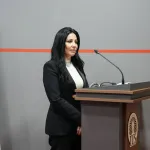
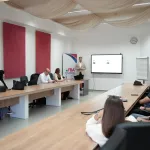
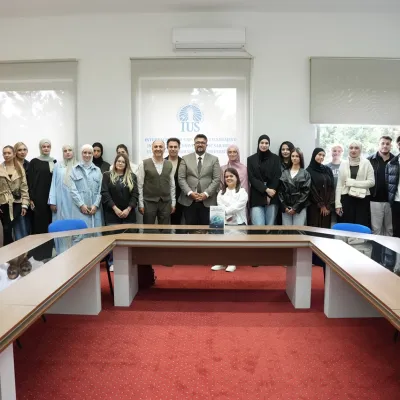
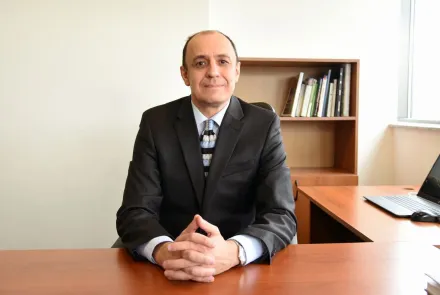
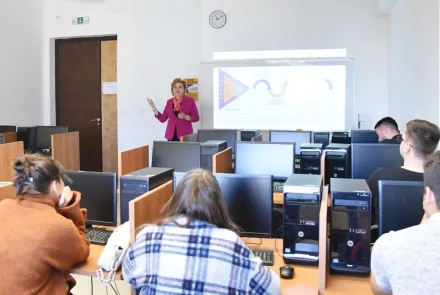
On Friday, November 14, 2025, the Faculty of Business and Administration (FBA) at the International University of Sarajevo (IUS) proudly hosted Ms. Nataša Vukmirović as a distinguished guest lecturer for the Introduction to Management course. This course, guided by Prof. Dr. Senad Bušatlić and adjunct instructor Dr. Aida Akagić-Hodžić, aims to provide students with foundational knowledge in management principles and contemporary organizational theories. Ms. Vukmirović’s participation brought a unique practitioner perspective to complement the academic curriculum.
Ms. Vukmirović is a highly accomplished consultant and internationally accredited coach and mentor, holding certifications as a supervisor and team coach. With over fifteen years of expert experience, she has collaborated extensively with organizations and leadership teams across civil society, the private sector, and public institutions throughout the Balkan region. This broad exposure equips her with deep insights into the challenges and dynamics faced by diverse organizational environments.
In her capacity as Director of the International Coaching and Mentoring Institute (ICM), founder of Coaching Plus School and the Business Coaching Academy, and owner of a United Kingdom-based company specializing in professional development and coaching, Ms. Vukmirović integrates practical coaching methodologies with cutting-edge management practices. Her multifaceted background allows her to connect theory with practice effectively, enriching students’ learning experiences and helping them develop competencies relevant to today’s competitive organizational landscapes.
During the lecture, Ms. Vukmirović addressed the pivotal subject of Organizational Structure and Design, a cornerstone of effective management. She elaborated on how organizational structure fundamentally shapes operational efficiency, communication flows, decision-making processes, and ultimately the organization’s capacity to achieve strategic goals. Her presentation emphasized the dynamics of structural change, illustrating how organizations must evolve their frameworks to remain adaptive in increasingly complex and value-driven environments.
To foster critical analysis, Ms. Vukmirović introduced case studies contrasting formalistic hierarchical structures with more flexible, adaptive models. Students critically examined the advantages and drawbacks of rigid versus flexible organizational designs, including how each impacts employee engagement, innovation, and responsiveness to external challenges. This comparative approach encouraged them to consider how structural choices align with organizational culture and strategic objectives.
The session was interactive, with students actively contributing to discussions on real-world issues such as organizational silos, resistance to change, and leadership roles in managing transformation. Through this dialogue, they explored practical problem-solving strategies that managers and leaders deploy to navigate complexities and drive meaningful organizational development.
By effectively bridging theoretical concepts from management studies with practical coaching insights, Ms. Vukmirović’s lecture enriched the academic discourse and equipped students with actionable knowledge. This experience enhanced their understanding of how leadership and organizational design intersect to influence overall organizational performance and sustainability.