

Call for Papers and Extended Abstracts - Values for Impact: Solidarity, Authenticity and Prosperity
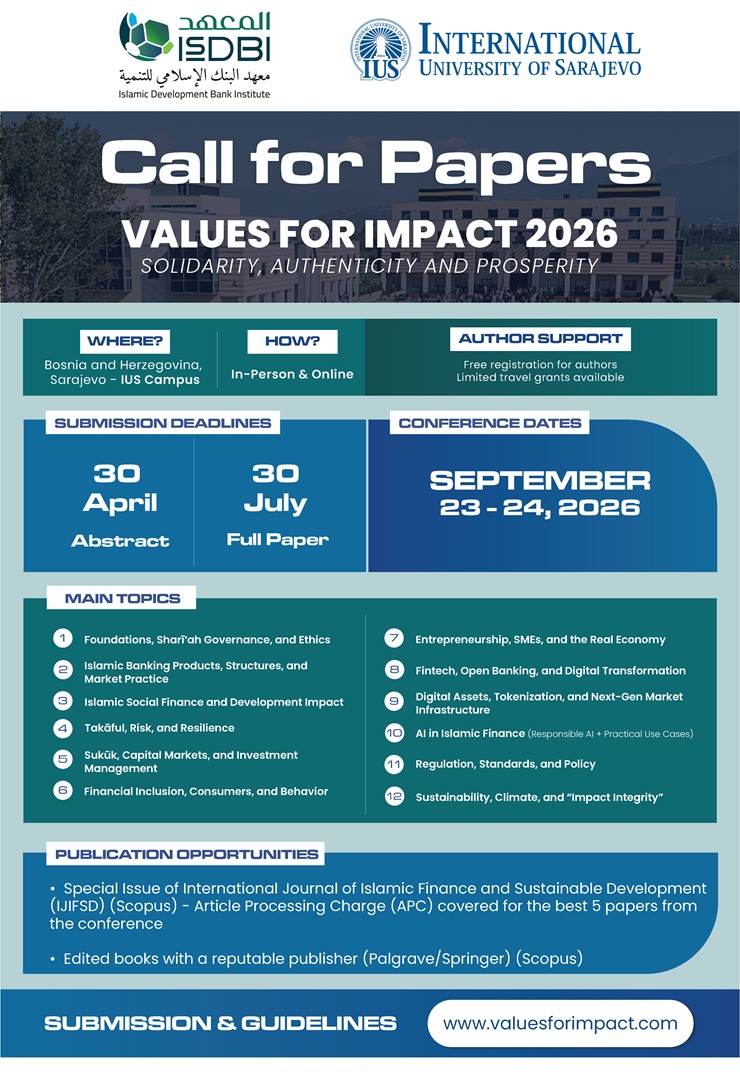
Date: September 23-24, 2026
Location: Sarajevo, IUS Campus
Format: Hybrid (In-person and online)
Participation: Free of charge
Sponsorship: A limited number of sponsorships are available for selected authors to support their participation in the conference.
Important Dates
- Submission deadline for Extended abstract (min 1000 words) and Author biography: April 30, 2026.
- How to submit: Authors need to register at www.valuesforimpact.com and use the Submit abstract option on the website.
- Notification of acceptance: May 15, 2026
- Full papers submission deadline: July 30, 2026
- Notification of full paper acceptance: August 15, 2026
- Conference dates: September 23-24, 2026
Organizers
The International University of Sarajevo (Faculty of Business and Administration), via its Center for Islamic Finance, Innovation and Sustainability, in collaboration with the Islamic Development Bank Institute (IsDBI), is pleased to co-organize a conference under the theme “Values for Impact: Solidarity, Authenticity, and Prosperity”, in Sarajevo, Bosnia and Herzegovina.
Under the theme Solidarity, Authenticity, and Prosperity, the conference will convene scholars, policymakers, regulators, and industry professionals to discuss how Islamic finance can promote solidarity-oriented and inclusive entrepreneurship, support authenticity through stronger real-economy linkages, and enable prosperity via trustworthy digital and AI-enabled financial services, while welcoming comparative perspectives on ethical and values-based finance.
The Islamic Development Bank Institute (IsDBI) is the knowledge beacon for the Islamic Development Bank (IsDB) Group, leading the exploration of innovative solutions for the economic challenges facing Member Countries and Muslim communities within the framework of Islamic economics and finance.
Established in 1981 as the Islamic Research and Training Institute (IRTI), the Institute was rebranded in 2021 as IsDB Institute to better align with the strategic priorities of the IsDB and enable the Institute to contribute tangible and sustainable value for enhancing the well-being of the IsDB Member Countries and Muslim Communities in Non-Member Countries.
Conference Themes
This conference will explore how Islamic finance, as a values-based system rooted in solidarity, authenticity, and prosperity, can contribute to entrepreneurship, inclusive development, and measurable impact. We welcome theoretical, empirical, policy, and practitioner-oriented papers that reflect these core values and examine their practical implications in local and global contexts. Key themes include:
A) Foundations, Sharī‘ah Governance, and Ethics
- Maqasid al-Sharī‘ah as an impact framework: conceptual models and measurable proxies
- Sharī‘ah governance effectiveness: board independence, conflicts of interest, and disclosure
- Standardization vs. diversity of Sharī‘ah opinions: implications for cross-border products
- Sharī‘ah audit practices: assurance models, reporting quality, and market confidence
- Fatwa transparency and stakeholder trust: empirical evidence from disclosure regimes
- Ethics of debt and over-indebtedness in Islamic retail finance
- Gharar, maysir, and speculation: contemporary applications in modern markets
- Benchmarking (e.g., interest rate benchmarks) and the authenticity debate: policy and product implications
- Consumer protection and fairness in Islamic financial contracts (fees, penalties, restructuring)
B) Islamic Banking Products, Structures, and Market Practice
- Mushārakah dominance: causes, consequences, and pathways to diversification
- Scaling mushārakah /muḍārabah: risk, governance, and incentive design
- Ijārah and asset-backed finance: operational challenges and Sharī‘ah controls
- Salam and istisna for agriculture/manufacturing: viability and impact potential
- Hybrid structures for SME financing: combining trade-based and partnership modes
- Islamic treasury operations: liquidity instruments and Sharī‘ah-compliant money market innovation
- Profit rate risk management in Islamic banks: tools, governance, and disclosure
- Product innovation lifecycle: from Sharī‘ah concept approval to customer outcomes
C) Ṣukūk, Capital Markets, and Investment Management
- Ṣukūk market development: determinants of depth, liquidity, and pricing efficiency
- Corporate vs sovereign ṣukūk: risk profiles, spreads, and investor behavior
- Default, restructuring, and legal enforceability in ṣukūk: lessons learned
- Ṣukūk documentation standardization and dispute resolution: cross-jurisdiction analysis
- Sustainability-linked / KPI-linked ṣukūk: credibility, structure design, and verification
- Social ṣukūk and outcomes-based ṣukūk: measuring real-world impact
- Islamic funds performance: screening, style factors, and risk-adjusted returns
- Sharī‘ah screening beyond “ḥalāl” sectors: integrating labor, environment, and harm prevention
- Islamic indices and passive investing: market impact and governance issues
D) Takāful, Risk, and Resilience
- Takāful penetration gaps: demand drivers, trust barriers, and product design
- Microtakāful models for low-income communities: sustainability and scale
- Takāful for SMEs: business continuity, climate risk, and supply chain disruption
- Retakāful capacity, concentration risk, and systemic vulnerabilities
- Operational risk, model risk, and Sharī‘ah non-compliance risk: integrated frameworks
- Climate risk stress testing for Islamic financial institutions: methods and findings
E) Islamic Social Finance and Development Impact
- Zakāt effectiveness: targeting, governance, and measurable poverty-exit pathways
- Digital zakāt platforms: transparency, leakage reduction, and trust outcomes
- Waqf governance reform: investment policy, accountability, and performance metrics
- Cash waqf and waqf-linked investment vehicles: structure innovation and risk controls
- Blended finance using zakāt/waqf + commercial capital: models and case evidence
- Qard hasan at scale: institutional models, sustainability, and moral hazard management
- Humanitarian and refugee finance through Islamic instruments: dignity-centered approaches
- Islamic social finance alignment with SDGs: evidence, measurement, and limitations
F) Financial Inclusion, Consumers, and Behavior
- Drivers of Islamic finance adoption: trust, religiosity, pricing, service quality, and literacy
- Financial literacy and consumer outcomes in Islamic finance markets
- Inclusion of unbanked groups: women, youth, migrants, rural communities - what works?
- Behavioral biases in Islamic investing: herding, moral licensing, and risk perception
- Ethical marketing vs. “halal branding”: consumer protection and disclosure standards
- Complaints handling and dispute resolution: service justice in Islamic banks/takāful
G) Entrepreneurship, SMEs, and the Real Economy
- Islamic finance for SMEs: barriers to access and collateral alternatives
- Cashflow-based SME financing in Islamic banks: models, data needs, and outcomes
- Islamic venture capital and private equity: Sharī‘ah structuring, governance, and exits
- Founder-friendly term sheets: aligning incentives and reducing moral hazard in partnership finance
- Islamic crowdfunding for startups/SMEs: performance, fraud risks, and regulation
- Incubators/accelerators + Islamic finance: ecosystem models that improve survival rates
- Linking financing to job creation: methods to measure employment and wage outcomes credibly
- Women-led entrepreneurship finance: product design, guarantees, and ecosystem support
- Youth entrepreneurship and skills-to-capital pathways: evidence from programs and pilots
- Halal supply chains and trade finance for SME exporters: traceability, working capital, and growth
- Family business succession and Islamic finance instruments: governance and continuity
H) Fintech, Open Banking, and Digital Transformation
- Islamic digital banks: performance, customer trust, and Sharī‘ah governance in digital-only models
- Open banking for Islamic finance: data-sharing consent, inclusion, and competition effects
- Embedded finance for SMEs: opportunities and consumer/SME protection risks
- RegTech and SupTech for Sharī‘ah compliance monitoring and reporting
- Islamic finance in platform economies (gig workers, marketplaces): fair financing models
- Cybersecurity and operational resilience in Islamic fintech ecosystems
I) AI in Islamic Finance (Responsible AI + Practical Use Cases)
- AI/ML credit scoring in Islamic finance: fairness, explainability, and bias mitigation
- AI in AML/CFT and fraud detection: effectiveness vs. privacy and false positives
- Model governance for AI in Islamic banks: accountability, auditability, and Sharī‘ah oversight
- Using LLMs for Sharī‘ah research support: benefits, risks, and governance (hallucinations, source control)
- AI-enabled personalization: ethical boundaries, consent, and manipulation risks
- Stress testing and early-warning systems using AI: performance and interpretability trade-offs
- Data quality and representativeness in Muslim markets: implications for AI outcomes
J) Digital Assets, Tokenization, and Next-Gen Market Infrastructure
- Tokenization of ṣukūk and real-world assets: legal enforceability and Sharī‘ah considerations
- Smart contracts for Islamic finance: operational efficiency vs. governance and dispute resolution
- CBDCs and Islamic finance: implications for liquidity management and financial inclusion
- Crypto-asset exposure and Sharī‘ah governance: risk, speculation, and consumer protection
- Digital identity and e-KYC infrastructure: inclusion gains vs. privacy risks
- Interoperability and cross-border payments: remittances, SME trade, and cost reduction
K) Regulation, Standards, and Policy
- Harmonization of AAOIFI/IFSB standards with local regulation: impacts on growth and stability
- Tax, legal, and insolvency frameworks: enabling genuine risk-sharing and restructuring
- Deposit insurance and resolution regimes for Islamic banks: design options and trade-offs
- Dual banking systems: competitive dynamics, stability, and consumer outcomes
- Disclosures and reporting requirements: Sharī‘ah, ESG, and impact reporting convergence
- Governance of sustainability claims: preventing greenwashing/impact-washing in Islamic products
L) Sustainability, Climate, and “Impact Integrity”
- Islamic finance and climate adaptation: financing resilience (water, food systems, infrastructure)
- Transition finance in emerging markets: balancing energy access and decarbonization
- ESG integration in Sharī‘ah-compliant portfolios: methods, performance, and authenticity
- Measuring impact through a Maqasid lens: frameworks, metrics, and assurance
- Nature and biodiversity risk for Islamic financial institutions: identifying and pricing externalities
- “Values-based finance” performance: does stronger ethics correlate with better long-run outcomes?
Publication Opportunities
Accepted papers will have the opportunity to be published in indexed journals or included in an edited book. Publication options include:
- Special issue of International Journal of Islamic Finance and Sustainable Development (IJIFSD) (Scopus) - Authors may choose to have their papers considered for the special issue. Conference organizers will cover the APC for the 5 best papers from the conference.
- Edited book with a reputable publisher (Palgrave/Springer) (Scopus)
Contact Information
For submission and general inquiries, please contact us:
- Email: conference@valuesforimpact.com
- Website: www.valuesforimpact.com
For more specific questions, you may reach out to:
- Admir Mešković - e-mail: ameskovic@ius.edu.ba or phone +387 61 907 111